
English| EUR
Suggested for you
More currencies
Choose a language
Anyone asking what is a gaucho in Argentina is usually asking two things at once: who these horsemen were, and what is left of them today. Both answers sit in the Pampas, the grassland belt beyond Buenos Aires, where working ranches still run on horseback. This page settles the definition and shows how it shapes a day spent on an estancia.
Quick answer
A gaucho is a horseman and cattle worker of the Argentine Pampas — a rural trade and identity, not a ticketed attraction, which is why no entrance fee applies (0 ARS). The Pampas Region has no single gate or street address. Visits happen through host estancias, and the useful window is daylight, roughly 09:00–17:00, when ranch work is actually visible.
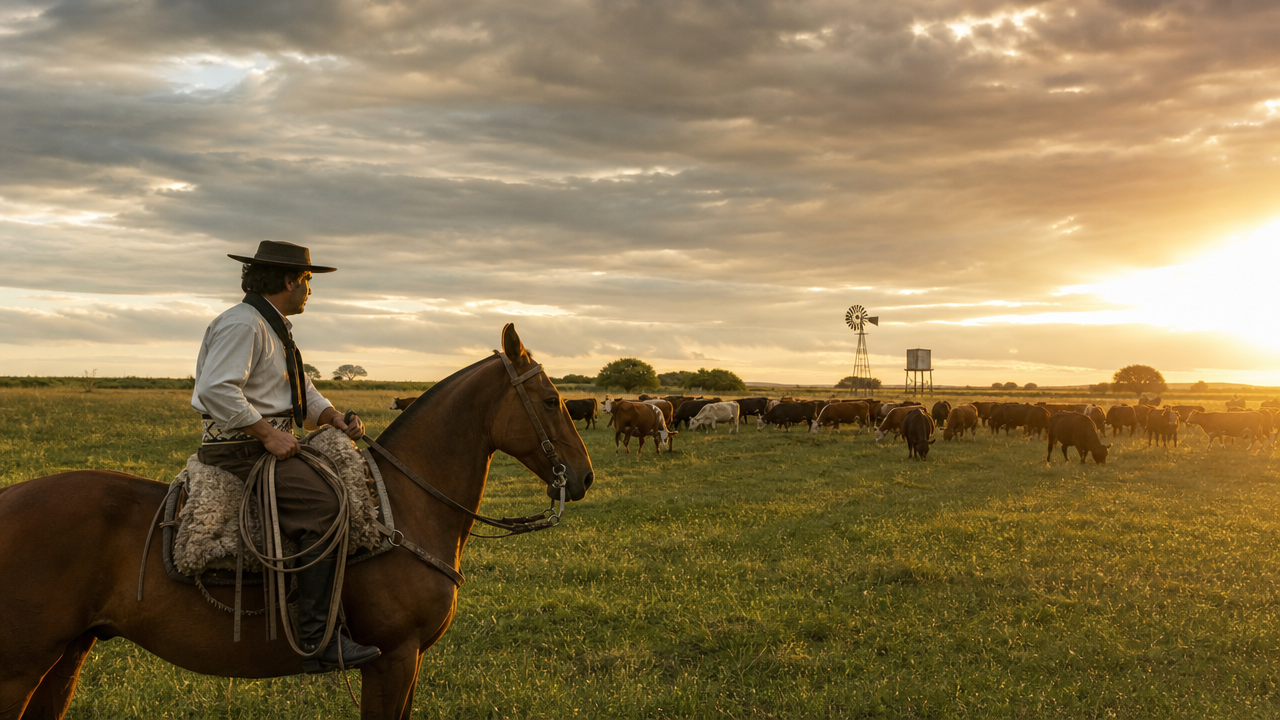
Argentina's national epic, José Hernández's Martín Fierro, was published in 1872 and written entirely in the voice of a rural horseman — a measure of how completely one figure entered the country's self-image. Travellers researching what is a gaucho in Argentina usually arrive expecting a costume and find an occupation instead. The word describes a working horseman of the Pampas, the grassland plain that spreads west and south from Buenos Aires across several provinces. Cattle, not spectacle, built the role. Gaucho culture grew out of open range, criollo horses and long distances, and its markers — the facón knife, wide bombachas trousers, a silver-studded rastra belt, mate passed hand to hand — are tools and habits before they are folklore. That inheritance is why the modern estancia tour looks the way it does. The 1872 poem's popularity coincided with the fencing of the open range, and the free-ranging life it described was already ending as it was being written. Working ranches across Buenos Aires Province and around San Antonio de Areco keep the skills alive in daylight hours: doma taming, the sortija ring race, herding a tropilla across open ground, an asado turned slowly over embers. Peones on those estancias still ride for a living, and demonstrations follow the rhythm of the working day rather than a performance schedule. Argentine gaucho traditions also survive off the ranch — in payada verse duels, in Día de la Tradición celebrations each November, in the pulpería country stores that once served as post office and bar. For a visitor, the practical consequence is straightforward. There is no gate, no turnstile and no single address to reach; the Pampas region is the setting, and access comes through a host ranch that opens by arrangement. Anyone planning a gaucho day trip from Buenos Aires should think in terms of hosts and daylight rather than queues, and should read the answer to what is a gaucho in Argentina as the description of a living rural trade. Ask what the estancia actually farms, whether the riders are staff or hired performers, and whether lunch is a genuine asado. A well-run ranch will answer all three plainly. The sections that follow set out timing, seasons and travel detail; this one settles the definition.
“Cattle, not spectacle, built the role.”
The gaucho serves as the quintessential symbol of Argentine rural identity, representing a nomadic, expert horseman deeply connected to the land. Their presence remains central to the operational traditions of the Pampas region.
The gaucho emerged in the 18th and 19th centuries as a skilled frontiersman whose lifestyle revolved around livestock management and life on the open plains.
Gauchos are characterized by their extreme independence and proficiency in horsemanship, serving as the primary caretakers of cattle across vast Argentine estancias.
Standard gaucho dress includes bombachas (loose-fitting trousers), a facón (large knife), and a rastra (a wide belt decorated with silver coins).
Historically, the gaucho diet consisted almost exclusively of beef, often prepared as asado, which is meat slow-roasted over an open fire.
The technical expertise of the gaucho lies in their ability to manage semi-wild cattle herds across the Pampas using horses and specialized rope techniques.
These cultural figures are intrinsically linked to the Pampas, a vast, fertile South American lowland that defines the landscape of the Argentine interior.
Drinking mate, a traditional herbal infusion, is a fundamental social ritual for gauchos, symbolizing hospitality and communal bonding during breaks in labor.
The facón is a multifunctional tool for the gaucho, used for everything from preparing meals and butchering cattle to personal defense.
The story begins with escaped livestock. When Pedro de Mendoza's first Buenos Aires settlement collapsed in 1541, the horses and cattle left behind multiplied across the open grassland. By the 1600s these ganado cimarrón herds numbered in the millions, and a class of mounted hunters formed around them. To ask what is a gaucho in Argentina is first to describe that 18th-century figure: a rider of mixed Spanish and indigenous descent who killed wild cattle for hides and tallow, carried a facón knife and boleadoras, and answered to no landlord. Authority moved against him early. The Viceroyalty of the Río de la Plata, created in 1776, treated unattached riders as vagrants. A 1785 ordinance required them to carry papeleta work passes; men found without one were pressed into frontier garrisons. Independence hardened the pattern. Gaucho cavalry rode with José de San Martín across the Andes in 1817, and Martín Güemes led irregular horsemen against royalist columns in Salta until his death in 1821. Under Juan Manuel de Rosas, governor from 1829, the pampas passed into private hands, fenced and titled. Wire changed everything. Barbed wire arrived on Argentine estancias from 1876, alfalfa pasture followed, and the Sociedad Rural Argentina pushed refrigerated beef export after the first frigorífico shipments of 1883. The free hunter became a wage-earning peón. The reversal came in print: José Hernández published Martín Fierro in 1872 and its sequel in 1879, and Ricardo Güiraldes issued Don Segundo Sombra in 1926 — the outlaw recast as national ancestor. Any Buenos Aires estancia tour meets that inheritance directly. What is a gaucho in Argentina today is a working estancia hand: he rides in bombachas and a rastra belt, brands and drives cattle, and rests his horse under recado sheepskin — the same gear the 1785 magistrates once used to identify a man with no fixed employer.
Horses and cattle abandoned at the failed first Buenos Aires settlement breed freely across the pampas.
The Viceroyalty of the Río de la Plata is created, bringing colonial administration to the grasslands.
An ordinance requires riders to carry a papeleta work pass or face forced military service on the frontier.
Gaucho horsemen serve in San Martín's Army of the Andes during the crossing into Chile.
Martín Güemes, commander of the gaucho irregulars in Salta, dies of wounds received in combat.
José Hernández publishes Martín Fierro, casting the persecuted gaucho as a national figure.
Barbed wire begins enclosing estancia land, ending open-range work and turning riders into wage peones.
Ricardo Güiraldes publishes Don Segundo Sombra, fixing the estancia gaucho in Argentine literature.
The best arrival window for observing traditional estancia routines is 09:00–17:00. Daylight hours during this span provide the necessary visibility to watch gauchos engage in daily fieldwork and livestock management.
Mild, 15°C to 24°C
Optimal conditions for outdoor activities and comfortable temperatures for all-day observation of estancia tasks.
Warm to hot, 20°C to 30°C
Long daylight hours allow for extended viewing, though midday periods can reach peak heat.
Cool to mild, 12°C to 22°C
Stable weather and pleasant conditions offer steady opportunities to observe seasonal gaucho traditions.
Chilly, 8°C to 16°C
Fewer visitors are present, though outdoor work routines may be shorter due to limited daylight.
Verdict: The best time to visit is during the spring months of September to November, arriving between 09:00 and 17:00 to ensure full visibility of activities.
The Pampas region is accessible for observation throughout the week, though official estancia operations remain closed to the general public. Individual private estates may set their own specific visitor policies.
The Pampas region is situated in the interior of Argentina, surrounding the city of Buenos Aires. Most visitors access the region via private transport or organized estancia transport services traveling along National Route 7 or Route 205.
National Route 7 or 205 to rural access roads
Long-distance coach from Retiro Bus Terminal
Private hire from Buenos Aires city center
The best arrival window is 09:00–17:00. Arriving within these hours ensures visibility for observing traditional estancia activities.
Everything you need to know about what is a gaucho in argentina
A gaucho is a skilled horseman and cultural icon of the South American plains, often compared to the North American cowboy. Understanding what is a gaucho in argentina requires looking at their historical role in livestock management and rural life.
Yes, these figures remain active in modern rural life, continuing traditional ranching methods passed down through generations. Travelers interested in what is a gaucho in argentina often observe these practitioners working on livestock estates throughout the countryside.
Visitors can tour working ranches to experience the lifestyle firsthand through an estancia tour. These excursions provide deeper insight into what is a gaucho in argentina and how they maintain the heritage of the Pampas.
They are famously skilled in horsemanship, cattle herding, and traditional leatherworking. The cultural identity of these individuals is central to the history of the region and remains a significant aspect of Argentine folklore.
An estancia visit typically includes observing field demonstrations, learning about traditional cooking, and seeing the rural landscape of the Pampas. These tours offer a structured way to engage with the environment and history associated with these legendary figures.
There is no specific entrance fee for observing the cultural heritage of these rural figures. Because they are not an attraction venue, you simply visit the region where they work and live.
The most effective approach is to book an organized estancia tour that focuses on regional heritage and authentic rural practices. This allows for direct observation of daily activities while supporting the local communities that keep these traditions alive.
Best Gaucho Tours in Buenos Aires
Read more Tickets & toursGaucho Day Tours from Buenos Aires
Read more GuideThe Cultural Importance of Gauchos
Read more GuideAre There Still Gauchos in Argentina?
Read more Tickets & toursPrivate Gaucho Tours in Buenos Aires
Read more Tickets & toursSan Antonio de Areco Ranch Tours
Read more Tickets & toursGaucho Ranch Tours
Read more