
English| EUR
Suggested for you
More currencies
Choose a language
The gaucho occupies a place in Argentine identity that no other figure holds — soldier, outcast, poet's subject, and finally national emblem. This why are gauchos important to argentina guide explains how that transformation happened and what remains visible on the land today. It also sets out the practical frame for seeing it: where the estancias are, and when the working day begins.
Quick answer
Gauchos matter to Argentina because the country built its national identity around them, adopting the horseman of the Pampas as the emblem of independence, self-reliance and criollo culture. Estancia regions carry no entrance fee — 0 USD — with access open 08:00–19:00 daily; individual estancias are private businesses charging their own tour fees. Arrive between 08:00 and 10:00, when livestock work actually happens.
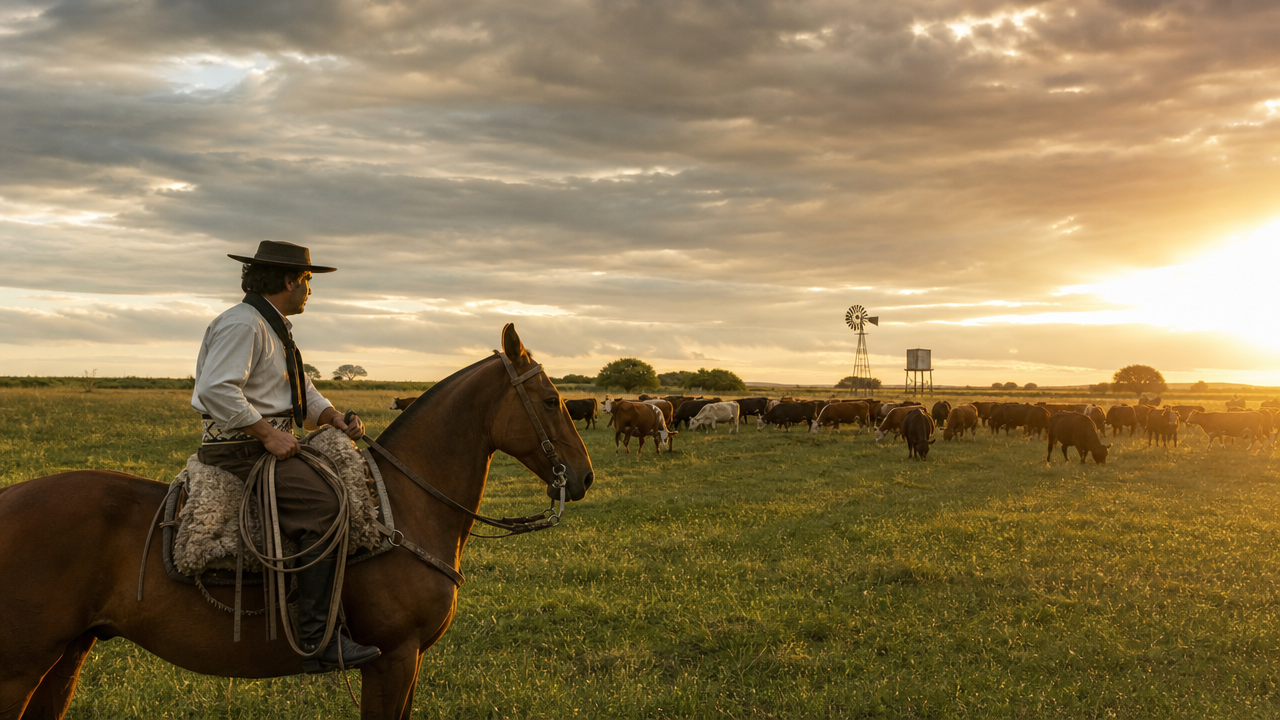
In 1913 the Argentine state made a literary decision with lasting consequences: Leopoldo Lugones delivered a series of lectures arguing that José Hernández's poem Martín Fierro was Argentina's national epic. The subject of that epic was a man the state had spent the previous century conscripting, fining and driving off the land. Within a generation the gaucho had moved from vagrancy statutes to schoolbooks. That reversal is the shortest possible account of why are gauchos important to argentina — the figure was rehabilitated precisely when the country needed a symbol that was neither Spanish nor immigrant, but criollo and born of the Pampas itself. The substance beneath the symbol was real work. Gauchos emerged from the mingling of Spanish, Indigenous and mestizo populations across the grasslands, living off feral cattle herds that multiplied on open range. Their toolkit is now shorthand for the culture: the facón knife worn at the back of the belt, the boleadoras thrown to bring down cattle at the legs, the rastra belt heavy with silver coins, the bombachas trousers, the poncho, the recado saddle built from stacked layers of hide and sheepskin. Mate, drunk from a gourd and passed in sequence, remains the social ritual that binds a work crew. When barbed wire fenced the Pampas in the 1870s and 1880s, the open-range life ended and the gaucho became a wage-earning peón on someone else's estancia. Cattle ranching in Argentina still runs on that labour, which is the reason a gaucho tour near Buenos Aires is not a costume exercise: the skills demonstrated are the skills the ranch uses. Visitors encounter this through the estancia, the ranch complex that organises rural Argentina. Estancias are scattered across the Pampas and Patagonia rather than gathered in one place, and there is no single gate or ticket booth — access to the region carries no entrance fee, while each estancia operates privately and sets its own terms. The rhythm of the day, not the price, is what shapes a visit. Livestock is moved early. Horses are saddled early. Demonstrations of doma, the horse-breaking tradition, and of the sortija ring race are scheduled around actual chores, which is why the recommended arrival window sits at the front of the morning. Asado over a wood fire follows midday; folk music, the zamba and the chacarera, tends to arrive after the meal. Anyone comparing options among Buenos Aires countryside landmarks should read the schedule for these anchors rather than for the headline attractions. The answer has a practical use. Understanding why are gauchos important to argentina changes what a visitor looks for once on the property: not a performance, but continuity — the way a foreman calls a herd, the way the recado is stacked, the way mate circulates without being asked for. The Día de la Tradición on 10 November, marking Hernández's birth, is the calendar's formal acknowledgment of that continuity, and estancia programmes across the provinces expand around it. For travellers planning a día de campo, the useful next step is to check each estancia's own operating detail against the day's rhythm, then match it to how far outside the capital they are willing to travel.
“The gaucho moved from vagrancy statutes to schoolbooks within a single generation.”
The gaucho was born of surplus. Spanish expeditions abandoned cattle and horses on the Pampas in the sixteenth century; by the 1700s these herds ran wild in the millions. Men of mixed Spanish, Indigenous and African descent hunted them for hides and tallow, living beyond parish records and colonial tax rolls. Bourbon officials called them vagos y malentretenidos — vagrants — and issued repeated ordinances demanding they carry papeleta de conchabo, proof of employment. The question of why are gauchos important to argentina begins with this friction between a mobile rural population and a state that could not govern it. War made them indispensable. During the British invasions of Buenos Aires in 1806 and 1807, mounted rural militias proved their worth against regular infantry. Martín Miguel de Güemes, governor of Salta, then commanded gaucho irregulars from 1814 to 1821 in the guerra gaucha, holding the northern frontier against six royalist advances without a standing army. His men fought with lasso, facón and boleadora. Güemes died of a wound in June 1821. Later, the montoneras of Facundo Quiroga and the federalist cause under Juan Manuel de Rosas drew on the same horsemen, and Domingo Faustino Sarmiento's Facundo (1845) cast them as the barbarism civilisation must erase. The rehabilitation came through literature. José Hernández published El Gaucho Martín Fierro in 1872 and La Vuelta de Martín Fierro in 1879, protesting the conscription of rural men into frontier forts. Ricardo Güiraldes followed with Don Segundo Sombra in 1926. By then barbed wire, the 1880s railway boom and refrigerated shipping had ended open-range droving. Argentina answered by canonising what it had dismantled: Día de la Tradición was declared on 10 November, Hernández's birthday, and the Museo Gauchesco Ricardo Güiraldes opened at San Antonio de Areco in 1938. On any estancia tour across the Pampas and Patagonia, that inheritance is legible in the fabric — colonial casco walls, the cattle chutes, harness rooms hung with rastra belts and mate gourds. Watching a domador work a young horse in the corral answers why are gauchos important to argentina more plainly than any archive: the craft outlived the frontier that required it.
Pedro de Mendoza's expedition leaves horses on the Río de la Plata, seeding the wild Pampas herds.
Bourbon ordinances require rural workers to carry a papeleta de conchabo or face conscription.
Mounted rural militias help repel the British invasions of Buenos Aires.
Martín Miguel de Güemes commands gaucho irregulars defending Salta in the guerra gaucha.
Sarmiento's Facundo frames gaucho life as the barbarism opposing civilisation.
José Hernández publishes El Gaucho Martín Fierro, protesting frontier conscription.
Barbed wire, railways and refrigerated shipping end open-range droving.
The Museo Gauchesco Ricardo Güiraldes opens at San Antonio de Areco.
The gaucho remains a central figure in Argentine identity, representing a unique blend of nomadic independence and rural expertise. Their customs continue to shape local social interactions and pastoral methods across the country.
The gaucho lifestyle defined the early Argentine frontier, establishing the foundation for the nation's cattle-based economy and pastoral traditions. Martín Fierro by José Hernández remains the most significant literary work capturing their ethos.
The ritual of drinking mate is a core social custom inherited from gaucho culture. It serves as a communal practice where the sharing of the infusion symbolizes friendship and egalitarian connection.
Gauchos traditionally wore the chiripá, a cloth wrapped around the waist to facilitate movement while riding. This garment evolved into the modern bombachas de campo trousers still worn by workers today.
The facón is a long, versatile knife central to the gaucho's daily life. It functions as a tool for preparing food, repairing gear, and self-defense in the rural environment.
Payadores are gaucho poets who engage in improvised musical duels using guitars. This oral tradition preserves regional history and demonstrates the value placed on wit and linguistic skill.
The social conduct of the gaucho emphasizes loyalty, hospitality, and self-reliance. These values persist in the gaucho code, which dictates respect for fellow travelers and stewardship of the land.
This plan suits first-time visitors travelling out from Buenos Aires for a single full day at a working estancia in the Pampas, and runs roughly nine hours door to door. Arriving between 08:00 and 10:00 leaves room for the whole sequence of demonstrations without rushing the drive back.
Most estancias sit 60–120 minutes from the city, so allow a two-hour buffer for pickup and traffic on the Ruta 8 or Ruta 205 corridors. Bring a light jacket; the Pampas mornings run cool even in summer.
Reception usually begins with empanadas and a first round of mate in the casco, the estancia's main house or courtyard. Expect 30–45 minutes to settle in and meet the resident gauchos.
A guided loop of the stables, corrals and grounds explains how the working ranch is organised day to day. Wear closed shoes; paddock ground turns uneven and dusty.
Riders head out across open pasture for about an hour, with a horse-drawn sulky offered as the slower alternative. Ask for a calm mount if you have not ridden before.
The parrilla lunch is the long centrepiece of the day, typically 90 minutes, often with folk guitar and a pericón dance demonstration between courses. Pace yourself, several cuts arrive in sequence.
The afternoon centres on the carrera de sortija ring race, plus lasso and boleadora handling in the open field. Stand behind the marked line, the riders pass at speed.
A final mate circle and a look at silverwork or leather gear close the visit before the return transfer. Confirm your departure time on arrival, most groups leave by 17:00.
Access to the Pampas and Patagonia regions is generally open to the public without charge. Specific entrance fees for individual estancias are determined independently by each private business based on the tour services they provide.
Verdict: Visitors typically pay 0 USD to access the region, while total costs fluctuate based on the specific estancia tour package selected.
Estancias across the Pampas and Patagonia region maintain consistent daily operating hours to accommodate visitors interested in gaucho traditions. Planning your visit within the standard window ensures availability for rural demonstrations.
Everything you need to know about why are gauchos important to argentina
The gaucho is a fundamental symbol of national identity, representing the independence and resilience of those who shaped the country's rural traditions. Understanding why are gauchos important to argentina helps visitors appreciate the social and economic history of the vast plains. Their skills in horsemanship and animal husbandry remain integral to the country's agricultural heritage.
An estancia tour allows guests to witness traditional horsemanship, known as doma, and farm work firsthand. Observing these daily routines provides clear context for why are gauchos important to argentina in a modern, immersive setting. Many tours also feature traditional folk music and dance performances reflecting this heritage.
For the most complete experience, arrive between 08:00 and 10:00 to see morning rural activities. This window is optimal for witnessing the authentic lifestyle that explains why are gauchos important to argentina. Later arrivals may miss the full scope of demonstrations scheduled throughout the day.
Entrance to these private rural businesses is 0 USD, meaning there is no general admission fee. However, individual estancias operate as private businesses that charge their own tour fees for services and activities. Guests should consult specific booking information to confirm costs for their chosen rural excursion.
Yes, these tours are generally family-friendly and offer a great way for children to learn about rural life. Seeing horses and livestock in their natural environment helps younger generations understand why are gauchos important to argentina and their ongoing impact on local food production. Most locations provide safe, open spaces and educational demonstrations suitable for all ages.
The gaucho emerged as a nomadic, skilled horseman in the 18th and 19th centuries, playing a crucial role in the development of the livestock industry. Their independence and connection to the land are key reasons why are gauchos important to argentina. These figures essentially served as the backbone of the rural economy, bridging the gap between wild herds and the global market.
Visitors should bring comfortable, weather-appropriate clothing suitable for rural terrain and potential temperature changes. Sunscreen, a hat, and sturdy footwear are recommended for exploring the grounds of an estancia. Having these items ensures you stay comfortable throughout your stay as you observe the traditions that make up this unique culture.
Best Gaucho Tours in Buenos Aires
Read more Tickets & toursGaucho Day Tours from Buenos Aires
Read more GuideWhat is a Gaucho in Argentina?
Read more GuideAre There Still Gauchos in Argentina?
Read more Tickets & toursPrivate Gaucho Tours in Buenos Aires
Read more Tickets & toursSan Antonio de Areco Ranch Tours
Read more Tickets & toursGaucho Ranch Tours
Read more